
How long does it take for Insurers to get in touch after a road traffic accident? That’s a question we received recently in the following terms: “I was involved in an RTA two months ago. I have not heard from the insurance company yet. How long does it take for them to get in touch? The accident was not my fault.” A significant collision - with lots of post-accident worries It turns out this accident involved a rear end shunt at a junction. The vehicle was pushed right off the road by the impact. The injured driver who contacted us had been knocked unconscious as a result of the crash. He spent two nights in hospital, was off work for several weeks and lost wages. An incorrect assumption He had been driving his works van and thought that his employers’ motor insurers would take care of his claim for his injuries and his financial losses, including his loss of earnings. This was a classic situation where you, as the accident victim, have suffered injury through no Continue Reading
How To Get All The Crucial Details After A Road Traffic Accident
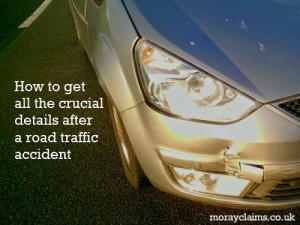
If you're involved in a RTA, there's crucial information you need to get We were on the main road south. We had not even made it out of Moray on our journey to Edinburgh. Accident A car approached from a minor road which formed a T-junction with our road, on our left. It should have given way to us but it didn’t; instead, it pulled out right in front of us and I could not stop in time. The front of our car hit the driver’s side of the other car, at the rear wheel arch. I had not been going fast and our speed at impact was probably less than 20 mph. Nevertheless, it was enough to cause the other car to spin right round, so it ended up facing into the junction it had come out of. What we did immediately after the accident I switched off the engine. I didn’t remember to switch on the hazard warning lights but my wife, in the passenger seat, did. I got out of the car and found the other driver was already out of his car. We established that both vehicles were Continue Reading
Occupiers’ Liability, Landlords and Tenants

Occupiers' liability may apply where a defective drain cover causes an accident on premises In this post, we are looking at situations where you might have a claim for injury following an accident on premises owned or occupied by someone else. In Scotland, the Occupiers’ Liability (Scotland) Act 1960, requires occupiers of premises to take reasonable care for people who come onto their premises to see to it that they are not injured due to the state of the premises. While this is a statutory duty, because the obligation imposed is to take reasonable care, you still have to prove fault, as under the general law of negligence. Often this will mean it is necessary to gather evidence about how long the hazard in question had been in existence before the accident. The argument you have to counter is that, if the defect had not been there for very long before the accident, there was not sufficient time for the occupier to identify it and repair it before any accident happened and so Continue Reading
Pavement Tripping Accidents (Maximising Your Claim’s Chances)
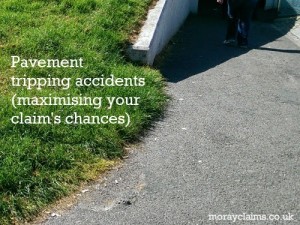
This post covers pavement defects and hazards which can cause you, as a pedestrian, to trip and fall. A separate post deals with situations where your injuries result from slipping in conditions of ice and snow. The trip hazard (towards the bottom of the above photo, below the bracket sign after the word “chances”) on the footpath pictured above was close to the north side of the underpass at Alexandra Road (A96), Elgin, and to our offices at 1 North Street. Part of a local authority’s responsibilities If you are injured as the result of a tripping accident on a public pavement or footpath in Scotland, any claim is usually directed against the local authority. In Moray, the responsible authority is The Moray Council. In most cases, the defect in the surface will be the result of erosion over many months (by contrast, in the above case, it was due to the surface of the footpath not being properly smoothed off at the time it was laid). Where an unexpected edge which causes a Continue Reading