Our blog shares clear, practical guidance on personal injury claims in Scotland — including fault, compensation, timescales, and dealing with insurers. Many of the articles answer questions we’re regularly asked by people who are unsure whether to claim, are dealing directly with insurers, or want to understand their rights before deciding what to do next. Start here: key guides Popular questions Common situations Back to the main blog page Editor’s note: This guide stays at the top of the list of blog posts to help new readers find key information. Continue Reading
Help from Personal Injury Assistant on the Grigor & Young Website

Moray Claims is part of Grigor & Young LLP, Solicitors, based in Elgin, Forres and Buckie in Moray. If you’re thinking about making a personal injury claim... ... and are not sure where to start, the online assistant on the Grigor & Young website can help. It can give you general information about things such as claim time limits, how the claims process works, and what a no win-no fee arrangement usually involves. The online assistant is designed to help you get clear, useful information quickly — including outside office hours. It cannot provide advice about your own particular circumstances and it is not a replacement for speaking with one of our solicitors, but it can be a helpful first step. Why not give it a try? If you would like advice about your own claim, please contact us directly via this website or call 01343 564813. Our personal injury team will be happy to help. Continue Reading
Help From The Other Driver’s Insurer (How To Avoid Being Misled)
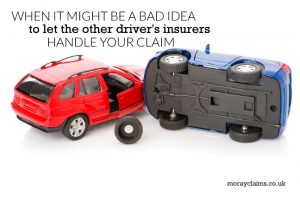
An "innocent third party car claim" is how some motor insurers describe what you have if one of their customers has crashed into your vehicle and it’s not your fault. In other words, the motor insurers in question are the third-party insurers, not your own motor insurers. Their customer was to blame for the accident. The third-party insurers’ offer to you is that you should let them take care of you and your vehicle in sorting things out. This help from the other driver's insurer can include: But couldn't you deal through your own insurers? If you have comprehensive motor insurance, one of your options is to deal with a claim for damage to your car through your own motor insurers. This can be an involved process. You may have to pay an excess on the policy. If your motor insurance comes up for renewal before the claim arising from the accident is sorted out, your insurance premium may go up (though you should be refunded any extra amounts you have had to pay for Continue Reading
What all can you claim for with a personal injury claim?
The style of lettering you use for words can have life and death consequences. Research by the AgeLab at Massachussetts Institute of Technology (MIT) has noted how car dashboard interfaces, if designed correctly, should minimise the amount of time the driver has to spend looking at them. The longer you take to work out what's on the screen, the less time you're looking at the road. Some typefaces are rigid and uniform. Their letters and numbers can look highly similar to each other. But other typefaces have much more open spacing and varied letter shapes. These latter fonts can shave precious milliseconds off the time drivers spend looking away from the road. Getting this form of visual communication right is important because the consequences for vehicle travellers' safety could be serious. With personal injury claims, one thing you need to get right in order to avoid potentially serious consequences is the valuation of the claim. With personal injury claims, Continue Reading
Bereavement Damages – Scots Law Used As A Benchmark For Reform
The Radio 4 consumer programme “You and Yours”, for 14 January 2016 (yes, more than 10 years ago), included a section on bereavement damages. It highlighted the fact that, although they say “you can’t put a price on a life”, in fact, we do it all the time. Decisions made about which treatments and drugs are going to be available on the NHS are one example. Another is the way we deal with compensation when someone dies as a result of negligence. NOTE: This article is an updated version of one which was originally published on this website on 25 January 2016. At that time, there seemed a real prospect that the law on fatal claims in England and Wales would be amended and brought into line with Scots law's 'more favourable' approach to bereavement damages. Shockingly, however, that has still not happened, despite more than a further decade having gone by. Scotland as a benchmark for law reform in England and Wales. As at January 2016, one MP – a former personal injury Continue Reading
