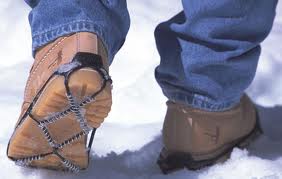
A recent Scottish court decision has potentially wide implications for you if you are an employer who requires your employees to work remotely in wintry conditions. It illustrates why it is important that employers keep up to date with advances in equipment technology which might make work safer, especially if the equipment is available relatively cheaply. Kennedy -v- Cordia (Services) - The Facts of the Case The injured person, Tracey Kennedy, was employed by Cordia Services as a home carer. One night in December 2010, together with a colleague, she had to visit a terminally-ill, housebound person in Crookston, Glasgow. At the time, Scotland was experiencing an extended period of wintry weather. There was snow and ice on the ground. As she walked down a path towards the house, she slipped and fell, breaking her wrist. She was wearing suede boots with a ridged sole. The boots were her own, not provided by her employer. The Legal Basis of the Claim The claim was based on Continue Reading
Bicycle and Motorcycle Accidents Reduction – Thanks to the Weather

Statistics published by the Department for Transport on 01 August 2013 reveal that the number of motorcycle and bicycle accidents on Great Britain’s roads has dropped since last year – something that can probably be attributed to the weather. The Quarterly Provisional Estimates record how many road accidents occur in the four quarters of each year. Experts can then analyse year-on-year trends, helping us to understand what effect the weather has on the safety of our roads. The most recent data makes for interesting reading because it shows the amount of motorcycle and bicycle accidents in the first quarter of 2013 (January to March) has decreased significantly from the same period in 2012. The number of pedal cycle casualties fell by 23% compared to the same period in 2012 while the number of motorcyclist casualties dropped by 27%. So what was the reason for the reduction in the number of accidents? The overall UK average temperature during the first three months of 2013 Continue Reading
Legal Aid for Personal Injury Claims in Scotland

These days, much of the focus is on “no win – no fee” arrangements but, in Scotland, civil legal aid is still available for personal injury claims. At Moray Claims / Grigor & Young about 50% of our personal injury caseload is covered by some form of legal aid. The First Stage of Your Claim – Advice & Assistance The initial stages of a claim can be covered by legal advice and assistance, a form of legal aid which allows work to be done in investigating the claim, including obtaining medical evidence, negotiating with the opponent and settling the claim if possible. The Scottish Legal Aid Board’s website has a calculator which allows you to check your likely eligibility for legal advice and assistance. Some people qualify fully, some not at all and, in the middle, some qualify but with the need to pay a financial contribution. Despite this, at Moray Claims / Grigor & Young, we never require payment of any advice and assistance contribution to be made. Your Continue Reading
Am I Likely To Lose My Job If I Claim For An Injury At Work?
The answer, in a word, is “no” – you are not likely to lose your job if you make a claim. If you have been injured in an accident in the course of your employment due to the fault of your employer, you might be worried that making a personal injury claim could lead to you getting the sack. Quite apart from the stresses and strains caused by your injury itself, the thought that you might lose your livelihood as well can be a strong off-putting factor in relation to making a compensation claim. Your concern might be either that your employment will be terminated as the direct result of making your claim or that the “atmosphere” it will create with your employers will be so bad that it will only be a matter of time before you will feel forced to resign because you will not be able to stand the pressure you are under. What is your employer’s duty to you? Employers have to take all reasonably practicable steps to ensure the safety of their employees at work. This includes Continue Reading