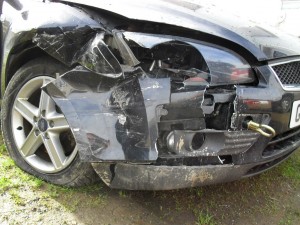
Rear-end collisions are usually blamed on the driver behind — but there are rare situations where responsibility can be shared. The general rule is that, if you run into the back of another vehicle, you will usually be held at fault and will not be able to claim against the driver in front. This is because drivers are expected to leave enough space to stop safely if traffic ahead slows or stops unexpectedly. This law seems to be generally well understood. What if the driver in front behaved unreasonably? Many people assume sudden or unexpected braking automatically shifts blame — in most cases, it doesn’t. From time to time, we get enquiries from people who have rear-ended another vehicle but consider that the accident was not their fault because the driver in front stopped their vehicle suddenly or without good reason. An example of this is where you are second in the queue at a T-junction and you and the car in front are both turning left. You can see there is Continue Reading
If You Are Injured By An Animal, Can You Make A Claim?
If an animal causes you an injury, can you make a claim for compensation? The modern law of negligence owes a lot to a mollusc but what if you have an accident in Scotland involving an animal – can you claim for your loss or damage? The Cow's Adventure One case from the 1950s involved a clever cow which managed to escape from premises in Inverness’s Eastgate, where it was due to be auctioned. It then managed to climb the stairway of a nearby property and fall through the floor into the shop below. In its struggles it turned on a tap, causing flooding. It also trampled and damaged stock. The Sheriff in that case decided there could be a successful claim against those responsible for the cattle at the time, if they could be shown to have been negligent. Dog Bites In our experience, the most likely injury scenario will involve a person being bitten by an animal, typically a dog. The law here is principally regulated by the Animals (Scotland) Act 1987. Liability Continue Reading
Personal Injury Damages Too Low (According to the People of Elgin – and Beyond)
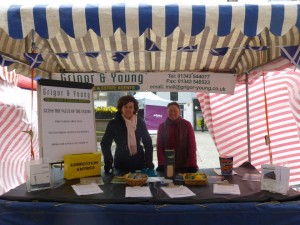
On 04 May 2013 – a cold and windy day in Elgin - three of us from Grigor & Young / Moray Claims (Ann, Eileen and Peter), took a stall at the Scottish Theme Day run by Elgin Business Improvement District (Elgin BID). Thank you to everyone involved in organising it and all who participated. We ran a competition where we asked people to give their valuation of the injury in the following scenario. Female, aged 42, at the date of the injury and 45 at the date of the hearing, sustained a deep laceration on her posterior left thigh as a result of sitting on a toilet which had a jagged broken edge. The wound bled profusely and she was taken to hospital where it was sutured with seven stitches under local anaesthetic. Approximately two weeks later the wound became inflamed and antibiotics were prescribed. She was unable to work for 10 days and had difficulties sitting down or sleeping on her back for some six to eight weeks afterwards. She was left with a permanent scar measuring 3cm by Continue Reading
Early Settlement of Personal Injury Claims: Bad News For Everyone?

We see this happening much more frequently following accidents involving personal injury. People, who are at their most vulnerable following injury, receive a call from the other party’s insurance company and then a letter offering settlement of their claim at a derisory level. Why? Well, settling the claim quickly is invariably cheaper for an insurer and they know that, without specialist advice, you may not be paid all that you are entitled to receive. If you have suffered a personal injury, it is generally only possible to value the injury part of the claim properly by obtaining medical evidence. The amount your injury is worth depends on things like: the nature and severity of the initial injury; and the length of time it takes you to recover from the injury. Getting medical evidence, including a report from an appropriate medical expert, should ensure that the compensation paid out at the end of the day is fair compensation. And that means “fair” not only to you Continue Reading