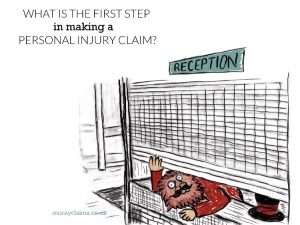
If you are injured or unwell and go to your local Accident and Emergency Department, you hope it is the first step on the road to recovery. Mr Darnley went to the A&E department of the Mayday Hospital in Croydon where he was told by the receptionist, in an offhand way, that it would be up to four or five hours before he was seen. After 19 minutes in the waiting area, Mr Darnley, who had head pain, decided to go home. Unfortunately, his condition deteriorated and he was taken back to the same hospital for a scan which revealed that he had bleeding on his brain. He was transferred to another hospital for neurosurgery but it was too late to prevent permanent injury - paralysis down one side of his body. In fact, the original receptionist had given Mr Darnley misleading information. Had he waited in A&E, he would probably have been seen within 30 minutes of his arrival - i.e. shortly after he left. Had he waited, his condition would probably have been diagnosed early enough Continue Reading
When you need to get copies of your Medical Records (Pitfalls to avoid)

“Can he really play?” “Heavens, no! He never played a note in his life” That’s the caption accompanying what is reckoned to be one of the most copied advertisements in history. The headline? "They Laughed When I Sat Down At The Piano - But When I Started to Play!" This 1927 newspaper masterpiece by John Caples has become a prime example of how to sell to people by tapping into their emotional desires through storytelling. The long-form advertisement was to promote a (free) book entitled “Music Lessons in Your Own Home”. Even the legendary comedian, Bob Monkhouse, copied the format for one of his best gags: “When I first said I wanted to be a comedian, everybody laughed. They're not laughing now.” Copying others’ style can apply whether you are writing an advertisement or a joke. Copying can also apply to medical records – and that’s what we’re looking at in this article. We’ll consider three questions relating to medical records in personal injury Continue Reading
Why First Consultation Free is not good enough for personal injury claims (and what is better for you)
Is one font better for your memory than another? Can the design of the typeface used to put information into a readable form make a difference to how well you will recall that information later? Research on this issue at RMIT University in Melbourne concluded that most of the fonts we see every day are similar. Their familiarity means we often glance over the words they form and no memory trace is created. On the other hand, at the other end of the spectrum, if typography is too different from the norm, the brain does not process it well and, again, we don’t retain the information. Is there a way to overcome this balancing act between over-familiarity and unreadableness? RMIT has developed the font, Sans Forgetica, which could be the answer. They say it lies at a sweet spot where, although the appearance of the font forms something of a barrier to the learning process, overall it helps the learning process rather than hindering it. They have proved this via a mixed lab Continue Reading
Why fraudulent personal injury claims are not more likely to appear in Scotland than elsewhere
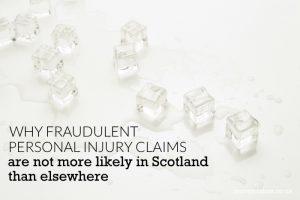
“Idiot insurance scammer fails miserably with fake ‘ice on floor’ fall”. That was one description of 57-year-old New Jersey man Alexander Goldinsky’s apparent attempt to stage a “slipping on ice cubes” accident in his work canteen. The incident – which happened sometime in the second half of 2018 - was captured on CCTV. Allegedly, he then filed a false insurance claim for the ambulance service and treatment he received at a local hospital for his "injuries" and the outcome was that he faced a criminal prosecution for fabricating the claim. Clearly, the USA is not Scotland but did you know that... ...within the UK, Scottish personal injury claimants are most likely to put forward exaggerated or fraudulent claims? This view has been expressed in the legal press by solicitors whose job it is represent the interests of insurers in defending personal injury compensation claims. Reforms to the law in England and Wales have meant that, in some claims where the injured person has Continue Reading