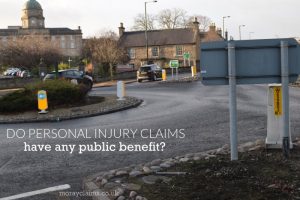
It's a myth that there is a Compensation Culture. It's a myth that personal injury claims drive up insurance premiums. But is it possible to show any real public benefit from personal injury compensation claims? Moray Claims / Grigor & Young LLP operates at a fairly local level and, in this article, we will look at 4 examples of ways in which personal injury claims by individuals have resulted – or could result – in changes which are of public benefit. 1. Removing a trip hazard A successful claim for a pedestrian who tripped on a raised piece of tarmac on the pedestrian footway close to the underpass at Alexandra Road, Elgin, resulted in the defect being repaired by Moray Council within a matter of days of the claim being intimated. 2. Properly marking/highlighting a trip hazard This raised area within Elgin bus station caused a pedestrian to trip and fall and suffer injury. It was never entirely clear why the plinth was there in the first place - possibly for an Continue Reading
Can an Adoptive Parent Claim for Nervous Shock as a Secondary Victim?
Here’s a question sent in to us via this website. Regarding your article 'How Nervous Shock Claims depend on whether you are a Primary or Secondary Victim' posted on 9th Dec 2016, I'm curious to know whether the mother of an adopted daughter can be regarded as a secondary victim? That article explained how Nervous Shock is not a medical term but instead one used by lawyers to describe a range of psychiatric conditions that can follow from an accident. Primary victims are people who are injured by being directly involved in the accident circumstances. Secondary victims are people who witnessed what happened to those directly involved in the accident but were not themselves “part of the action”. Claimants in the category of secondary victim suffer psychiatric injury because of fear for the safety of another. In general terms, it’s much easier to succeed with a Nervous Shock claim if you are a primary victim than if you are a secondary victim. For fear that an avalanche of Continue Reading
Moray Claims becomes a trading name of Grigor & Young LLP
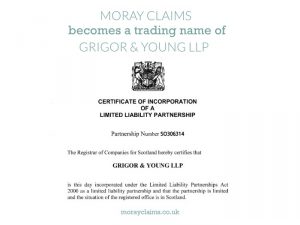
In the time since Moray Claims started up - in 2012 - it has been a trading name of Grigor & Young, Solicitors and Estate Agents. During that period, we have been able to help a lot of people in Moray and beyond to claim fair and full compensation for personal injury. In the recent past, we have moved past the 200 mark in terms of number of articles on our blog. Accordingly, there is a lot of information about personal injury claims in Scotland on the website - a resource you can search using the Search Form in the right-hand sidebar of each page (or, if you are using a mobile device, by scrolling further down this page). We have also produced some audio content in starting our Moray Claims podcast. The initial episodes reflect the written content on the site which has proven to be most popular. This is another area of knowledge distribution we hope to continue and expand. From 01 April 2018, Grigor & Young becomes a limited liability partnership. From that date, its Continue Reading
What are your rights following a road traffic accident that was not your fault?
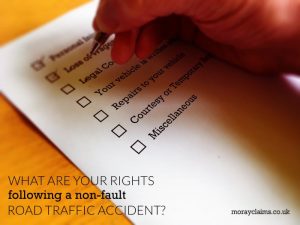
The Competition & Markets Authority (CMA) is a UK government department, responsible for strengthening business competition and preventing and reducing anti-competitive activities. In September 2014, it produced a report following an investigation into the private motor insurance market. One of the things they considered was the possibility of providing improved information to consumers on their rights following an accident. They noted that there appeared to be market-wide support for such a measure. CMA found a poor level of awareness among consumers about their basic rights following a road traffic accident that was not the consumer's fault. The report summarises the legal and factual background to its remit. It explains how the law requires motorists to hold a valid insurance policy to cover “third party” risks. In other words, insure against the risk they will injure another person or their property through their driving and have to pay compensation for those Continue Reading