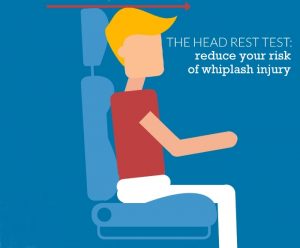
Whiplash gets a lot of negative press. It is a type of injury where there is scope for people exaggerating their aches and pains to get more compensation or even inventing them completely. The Westminster Government is currently on a mission to weed out spurious claims. On the other hand, if you have ever suffered a whiplash injury to your neck or back, you will know it is not something to be taken lightly. The injury is very real. Whiplash can cause a considerable amount of pain and inconvenience to the injured person. Everyone knows that prevention is better than cure and here’s an idea for simple action you can take to reduce the risk of you being the victim of a whiplash injury. It all boils down to proper adjustment of the head restraints in your vehicle. How best should you position the head rests in your vehicle? It is not sufficient to have a head restraint attached to the top of your seat. You must make sure it is adjusted to be in line with the top of your Continue Reading
Will I Have To Go To Court If I Make A Personal Injury Claim?
Many people worry that, if they pursue legal action, they will have to endure the stress and hassle of a court hearing (known as a ‘Proof’, in Scotland). We get this question time and again: "Will I have to go to court if I make a personal injury claim?" Solicitors and other legal professionals are more used to the court setting, of course, though it is not stress-free for them either. We understand that the prospect of having to go through court proceedings is daunting, perhaps to the point that it may put you off the idea of making a claim entirely. Most claims settle "out of court" It is important not to get too hung up on the idea that your claim will have to “go to court”. The main reason for this is that, in the vast majority of cases, claims are settled out of court – either because it is never necessary to raise a court action at all or because the claim settles after a court action is raised but before the Proof. The parties on each side of the claim will Continue Reading
Rural Road Accident Claims and Why Drivers Need to Take Extra Care

Rural roads account for over 70% of fatal accidents, according to statistics published by RoSPA. In Scotland, trunk roads, such as the A9 and A96, are maintained by independent companies but more minor roads are the responsibility of local authorities. Of course, the more minor roads tend to have a greater amount of bends and ups and downs. The increased dangers for drivers are obvious: whether it’s from other traffic, such as slow-moving farm vehicles, or from the state of the road itself. Roads authorities can rarely be blamed for accidents A Court of Session decision from June 2012 – arising out of a tragic accident in North-east Scotland - has provided a reminder of the considerable limitations on local authorities’ duties and the emphasis that is placed on the personal responsibility of the individual driver. In these cash-strapped times, the duties the law imposes on local authorities to maintain road markings and signage are not likely to increase in the foreseeable Continue Reading
Fatal Accident Claims: Different in Scotland

On 16 July 2009, Peter McGee fell down the stairs at his home in Springburn, Glasgow. Two days later, he died in hospital as a result of complications from his injuries. His wife, Catherine, and other family members raised an action in the Court of Session against RJK Building Services Ltd, who had carried out joinery work at the property on the instructions of Glasgow City Council, Mr and Mrs McGee’s landlords. In an Opinion issued on 18 January 2013, Lord Drummond Young found that RJK were to blame for Mr McGee’s injuries and death because they had been negligent in the way they fitted a handrail on the stairs. The handrail had come loose from the wall as Mr McGee descended the stairs, causing him to fall. A lengthy marriage At the time of his death, Mr McGee was 71 years old. His wife was a few months younger than him. They had been married for 36 years. An area of personal injury law where Scotland is different Personal injury law is applied identically or Continue Reading