
In Scotland, we are used to being lumped in with England and other parts of the UK in all sorts of situations where that may be misleading or even wrong. Sometimes the law is the same in Scotland as in the rest of the UK and sometimes it’s not. Personal injury claims are usually based upon negligence of one person causing injury to another. The modern law of negligence for the UK (and much of the world) is based on the Scottish “snail in the ginger beer bottle” case of Donoghue –v- Stevenson. But some areas of personal injury law differ markedly between the jurisdictions. For example, the law relating to claims in cases of fatal accidents and payment of bereavement damages to relatives of deceased persons. Scotland has had a more ‘generous’ compensation scheme in this type of case than the rest of the UK for a long time. But one area where there has been a parting of the ways between Scotland, on the one hand, and England and Wales, on the other, has come as recently as May Continue Reading
How personal injury claim funding got to its best-ever position in Scotland
In jokes, lawyers are never portrayed as the cream of society. Musicians like to make jokes about each other. Drummers and viola players are a bit dim; accordionists and banjo players are downright annoying (because their instruments are 'loud' and drown out others nearby). Here are a couple of cartoon-based jokes where lawyers and banjo players are on opposite sides. (A) Lawyer (probably a lawyer rather just a "businessman" - because his discomfort is doubly delicious) in a lift (elevator), talking on his mobile phone: "I'm trapped in an elevator. Wait it gets worse..." (The other occupant of the lift is a banjo player). It works better in the original... (B) Father to young child who is holding a banjo and standing on a chair to be high enough to see the music on their music stand: "Certainly a law degree is a worthwhile endeavour, son, but you need something to fall back on. Now practise your banjo." (Lawyers' response: Ouch). You wouldn't necessarily expect to be Continue Reading
How to instantly increase the value of your personal injury claim by 25%?
The comic strip featuring Calvin and Hobbes has many recurring themes. For example, the opinion poll results showing that Calvin's Dad risks failing to be "re-elected" as Calvin's Dad in upcoming elections (elections which never seem to materialise). Calvin: (e.g.) "You rate especially low among tigers and six-year-old white males." Calvin's Dad: (e.g.) "I take comfort in the fact that not many people would want the job (i.e. the job of being "Calvin's Dad")." Another recurring theme is Calvin's fear of maths problems. It does not help that Hobbes (his pet, stuffed tiger) helps him in class and with homework. For example, Calvin: "What's 7 + 3?" Hobbes: "73." In one class quiz, Calvin considers the following problem: "Jack and Joe leave their homes at the same time and drive toward each other. Jack drives at 60 mph, while Joe drives at 30 mph. They pass each other in 10 minutes. How far apart were Jack and Joe when they started?" Calvin stares helplessly at the Continue Reading
How an “off” petrol lawnmower can still be a powered-blade injury risk
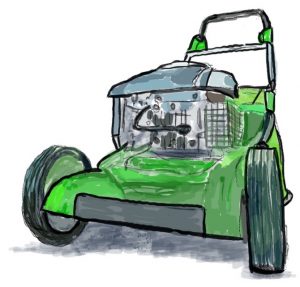
Imagine you've been cutting grass with a self-propelled rotary petrol mower - like the ones shown in various images in this article. (You don't 'push' such lawnmowers. They are propelled along by their engines). You stop the engine to adjust the height of the blade. While you're doing that, completely without warning and unexpectedly, the motor restarts of its own accord. The blade spins into action and you suffer serious injury to your hand as a result. Statistics from the USA show that there was an average of about 85,000 lawnmower-related injuries annually in the period 2005 to 2015. The most commonly injured body parts were the hand/finger (22%) followed by the lower extremities (i.e. toes) (16%). Men were more than 3 times as likely to be injured as women. The annual number of lawnmower-related injuries showed no decrease during the period 2005 to 2015. The purpose of this article is to highlight a particular risk associated with petrol-driven Continue Reading
