
'What have the Romans ever done for us?' is one of the most quoted scenes from Monty Python's iconic film, Life of Brian. John Cleese as Reg, leader of The People's Front of Judea, poses the question at a secret meeting of the group, expecting no or few positive responses from his colleagues. This, he hopes, will reinforce the group's resolve to overthrow their 'pointless' and unwelcome rulers. Instead, their brainstormed list of the benefits of Roman occupation grows and grows, with great comic effect. Exasperated, in an effort to bring the discussion to an end, Reg snarls: 'Alright - but apart from sanitation, medicine, education, wine, public order, irrigation, roads, the freshwater system and public health ... what have the Romans ever done for us?' (The next and final answer, before the meeting is suddenly interrupted by a threatening knock on the door, is: 'Brought peace'). The serious point, well made by this film scene, is that the influence of the Roman Empire in the Continue Reading
Lifting Operations Accident In Moray Firth Harbour Caused By Confusion In Communication
Confusion in communication is a common cause of accidents. It seems to have played a central role in a serious incident on the coast of the Moray Firth, recently reported on the Health and Safety Executive (HSE) website. A worker suffered facial and hand injuries as a result of an accident in Wick Harbour in January 2013 Brian Reid (‘R’), who was employed by a subcontractor, was lowered into the hold of a ship in a man riding basket lifted by a crane. Wind turbine components were to be unloaded from the ship. R was removing sea fastenings to enable the unloading to take place. Hugh Simpson (Contractors) Limited (‘HSCL’) was in charge of the lifting operation. Neither the basket nor R could be seen by the crane operator whilst R was in the hold of the ship The employee of HSCL who was in charge of lifting operations on the day was on the deck of the ship to provide a communication link between R and the crane operator by means of hand signals. After R had removed one of the sea Continue Reading
Manual Handling Accidents
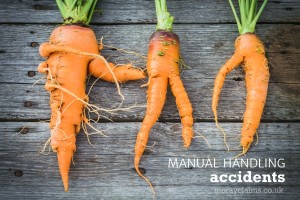
In rural California in the mid-1980s, Mike Yurosek had a problem which was common to all carrot farmers. More than half his crop was going to waste because it was considered too ‘ugly’ for retail. Carrots which were malformed, crooked or too large were written off as unsaleable and consigned to the bin. After some experimentation and some false-starts with different cutting implements, Yurosek settled on an industrial green-bean cutter, which cut the second-class carrots into regular 2-inch pieces. Unsure as to the reaction he would get, he sent a free bag of the alternative carrots with the usual delivery to one of his local retail clients. Next day, they called him to say that from then on they only wanted the new design of carrots. Yurosek had invented the ‘baby carrot’. In so doing, he lifted the carrot industry out of a rut. By 1987 – the year after his discovery – carrot consumption in the U.S. had risen by 30%. In the decade to 1997, carrot consumption doubled. Continue Reading
Supermarket Slipping Accidents
Growing up in the U.S. in the middle of last century, Irving Naxon’s mother told him stories of her own childhood in a small village in Lithuania. Every Friday afternoon, she took a pot of uncooked stew to the local bakery, where it was placed in the oven. While everyone observed the Jewish Sabbath on the Saturday, the dish simmered in the slowly cooling oven. By evening, it was cooked to perfection and ready to be collected and eaten by the family. Naxon was inspired by this story and, throughout the 1950s and 1960s, sought to develop a way of cooking which was both economical and environmentally friendly. His invention was the Naxon Beanery – a pot surrounded by a heating element which mimicked the cooking method from the Eastern European bakery. The ‘slow cooker’ was born. When Naxon retired in 1971, he sold his business. The new owners refined the cooker’s design and renamed it the Crock Pot. Today, crock pots are integral to American cooking: they’re low-effort, efficient and Continue Reading
