
It is extremely difficult to say how long a personal injury claim will take but the factors involved are not all within the control of the other party or their insurers, despite what some people think. “I know they will probably try to drag it out for years,” is a comment we often hear from people considering making a compensation claim for injuries suffered in an accident. "They" refers to the person or organisation responsible for paying the compensation that is due – which is usually, but not always, an insurance company. Your personal injury solicitor will constantly be keeping an eye on what is the next step required in relation to your claim. At any given time, your solicitor should be able to give a best estimate of how much longer it will all take. Factors which could have an effect on the length of your claim Some things which will affect how quickly your claim can proceed to a conclusion are: How complex the case is; The severity of your Continue Reading
Can I Choose My Own Personal Injury Solicitor?

The answer is generally “yes”. Please read on for an explanation. In many situations if you have been injured as the result of an accident, you will have other property losses that will be insured and you will be contacting your insurers to claim for those. The most common example is road traffic accidents. Your car may well have been damaged and you will contact your insurers to see about repairs or a replacement vehicle. Your motor insurers will these days usually ask you if you have been injured in the accident. If you have been injured, they will refer you on to a specific law firm as if it is “the normal thing to do”. It is important to be aware that there is a financial relationship between the insurers and the solicitors they recommend to you. The relationship operates on the basis that the insurance company agrees to pass on all their claims to the solicitors and the solicitors pay a referral fee for the privilege. It means that the recommendation is not necessarily Continue Reading
Winter driving means an increased risk of accidents: what steps should you take?
Wintry weather is persisting into March around the Moray Firth. Inevitably, in winter, there tends to be an increase in road traffic accidents. At this time of year, we are more likely to be driving in the dark and on roads affected by snow and ice. Repeated freezing and thawing also increases the number and size of potholes in the roads. What steps can you take? Equipment to carry in your vehicle The Royal Society for the Prevention of Accidents (RoSPA) recommends certain basic safety equipment to keep in your vehicle at all times, so you are prepared if the weather deteriorates. This should include a towrope, de-icing equipment, a spare wheel, a torch, a first aid kit and a warm blanket. Checks on the vehicle itself In addition, you should check that your vehicle itself is properly prepared for winter conditions. Check your tyre pressure regularly and ensure that you have sufficient tyre tread as this will reduce the risk of loss of traction and skidding (as well as improving Continue Reading
Why early settlement of your personal injury claim is probably a bad idea
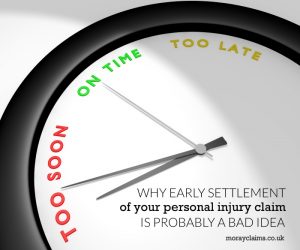
If you have been the victim of personal injury due to the fault of another person or organisation, you will be entitled to compensation. Among other things, you will receive damages for the pain and suffering of your injuries and for any financial loss you have incurred, such as wage loss. There is a process you need to go through to get proper compensation. However, we find more and more that insurance companies tell people in your position that this is unnecessary. It is increasingly the case that injured persons are contacted directly by the insurers for the other person or organisation - with an offer to settle their claim there and then. In some cases, this involves a representative of the insurers “door-stepping” the injured person and virtually bullying them into agreeing. It is all too easy to fall into the trap of believing what is implied in the close attention these insurers pay to you: that they have your best interests at heart. Remember that the insurer’s principal Continue Reading