We've talked about Qualified One-Way Costs Shifting (QOCS) before now because it is an important topic. In Scotland, the "normal rule" whereby an unsuccessful claimant for personal injury compensation will no longer have to pay court costs / expenses if the claim fails will have various exceptions. In these situations, the claimant will lose QOCS protection and have to pay the costs of their opponent. The claimant will only be liable for their opponent's expenses in Scotland where they have: We have waited three years for the QOCS regulations to come in. They were enacted from 30 June 2021. In many respects, the regulations mirror those already in force in England and Wales. The basic principle is the same and the exceptions are largely the same. Abuse of process, behaving manifestly unreasonably and also acting fraudulently or making a fraudulent misrepresentation. One big difference is that Scotland has not enacted any equivalent concept to England and Continue Reading
Deciding how best to respond to a Minute of Tender in practice
Tea drinking is a national pastime in Nepal. They have all sorts of teas - sweet, butter, hot, cold, black, white. The ritual with tea is that, when offered tea, you decline it and your host insists that you have some. No matter how much you say no, they still insist that you have it. So you drink it. In other words, it's a situation with drink consumption where "no" means "yes". With personal injury court actions, as the claimant, if your opponent offers you settlement via a Minute of Tender, you want to say "no" (because you always want them to make you a better offer). Unfortunately, you might find that however much you say "no", depending on the level of offer, your legal adviser may have to insist that you say "yes" and accept it. It's one of the situations that can happen with Minutes of Tender. You think your personal injury claim’s worth £20,000 but you’ve got a formal offer (Minute of Tender) in your court action to settle at £10,000. Should you accept the Continue Reading
Do you have any of these misconceptions about time limits in personal injury claims?
“The room is full of steam from the kettle but you still make the tea.” These were words of my school chemistry teacher. What was the point? That a small volume of water produces a large volume of steam. If you put water on to boil for a cup of tea but then get distracted by something else, you may return to find the room filled with steam but there will probably still be enough water left to make your brew. This idea that you can forget about something for a while, come back to it and the outcome will still be okay seems to be one that many folk with possible personal injury compensation claims have too. The problem is that personal injury claims are up against a hard deadline. In most cases, that deadline is 3 years from the date of the accident/injury. If you don’t settle your claim by negotiation within the 3-year period, you’ll have to raise a court action to keep the claim alive beyond the deadline - or lose the right to claim forever. It’s inevitable Continue Reading
What’s qualified one-way cost-shifting for personal injury claims in Scotland?
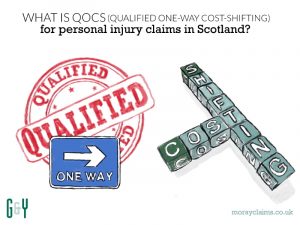
"Give me 10 men like Clouseau and I could destroy the world," These were the words of Chief Inspector Charles Dreyfus (Herbert Lom), long-suffering superior of the hilariously inept Inspector Jacques Clouseau (Peter Sellers) in the Pink Panther films of the 1960s and 70s. Another crucial supporting role to Clouseau was that of Cato Fong (Burt Kwouk – pronounced “Kwok”), the Inspector’s Chinese manservant, trained to spring regular surprise attacks on his boss to keep him alert and practised in martial arts. A prime example of Clouseau’s extreme destructive power is in one apartment scene where, with Cato’s assistance, he destroys not only a four-poster bed and a TV set but also inflicts structural damage on the flat below, occupied by the hysterically twitching Dreyfus. We could say that Burt Kwouk’s role was crucial in support of Peter Sellers’ performance. And, because we love a pun, we could also say that, in the context of personal injury claims, QOCS (which is Continue Reading
